Yttrium Oxide Purity Grades: 99.9% vs 99.99% vs 99.999%
US Stock: High-Purity Y₂O₃ Available in the USA
For teams comparing yttrium oxide suppliers in USA markets, selecting the right material is rarely a matter of simply choosing the highest purity number or the lowest yttrium oxide price. Indeed, the grade that suits an advanced ceramic body may differ from what an optical or electronic process needs, and two lots at the same stated purity can still behave differently in production. Therefore, this practical guide walks industrial buyers, procurement managers, and materials engineers through what the common purity grades mean, how to read a specification, and how to compare a yttrium oxide supplier on the full supply proposition rather than price alone. Ultimately, Neugen Labs supplies high-purity Y₂O₃ in the USA and offers this as a neutral, technical reference for teams researching their options.
Why Yttrium Oxide Purity Matters When Buying for Industrial Use
Purity describes how much of a Y₂O₃ (yttria, or yttrium(III) oxide) powder is the target oxide and how much is trace impurity. That balance matters because the small non-yttria fraction can influence downstream behaviour in several ways: chemical consistency, sintering and phase behaviour in ceramics, optical or electrical characteristics in more sensitive materials, and reproducibility from batch to batch. An impurity that is harmless in one process can be significant in another.
The important point for buyers is that the required purity depends on the application, not on a universal rule. A headline purity number tells you the total impurity ceiling but not which elements are present, so it does not, on its own, describe every characteristic of a material. Reviewing the full specification and impurity profile, and confirming the current specification or Certificate of Analysis with the supplier, is more reliable than judging a material by its percentage alone.
Understanding 99.9%, 99.99%, and 99.999% Y₂O₃
Yttria is commonly offered in a few standard grades, described by percentage or by the shorthand "N" notation, which simply counts the number of nines in the purity figure.
Three nines, a general industrial grade with a wider impurity margin.
Four nines, a tighter grade where impurity sensitivity increases.
Five nines, a high-purity grade for impurity-sensitive applications.
As the grade rises, the total impurity content falls. What the percentage does not tell you is the identity of the remaining impurities or the powder characteristics (particle size distribution and surface area, for example), which can differ even between lots of the same nominal purity. Treat the grade as one input into a decision, alongside the impurity specification and your application requirements.
99.9% vs 99.99% vs 99.999% Yttrium Oxide
The table below frames the three grades from a buyer's standpoint. It is written to guide questions rather than to declare a winner, the right grade is application-dependent.
| Purity Grade | Approx. N Grade | General Buyer Position | Potential Use Considerations | What to Confirm Before Purchase |
|---|---|---|---|---|
| 99.9% | 3N | May be suitable where the process tolerates a wider impurity margin | Often a starting point for cost-sensitive or higher-volume use | Whether the application is impurity-sensitive; the impurity profile |
| 99.99% | 4N | Can be preferred where tighter chemical consistency is needed | A common middle ground for demanding but not ultra-critical work | Which trace elements matter; specification requirements |
| 99.999% | 5N | Can be preferred for impurity-sensitive formulations | Application-dependent; relevant to optical, electronic and similar uses | Confirm the required grade and impurity limits with the supplier |
Moving up a grade is not automatically an improvement for a given process, it depends on impurity sensitivity. Confirm specification requirements against your own application before deciding.
When Should You Choose High-Purity Yttrium Oxide?
Higher-purity Y₂O₃ tends to become relevant as a process grows more sensitive to trace impurities. Common areas where it may matter include:
Advanced Ceramics
Consistency and impurity content can influence sintering and microstructure in ceramic bodies.
Electronic & Semiconductor Materials
Electronic and semiconductor-related uses can be sensitive to specific trace elements.
Optical & Laser Materials
Optical and laser-related materials may require tighter impurity control for their properties.
Thermal Barrier Coatings
Coating behaviour benefits from consistency; note that Y₂O₃ differs from yttria-stabilised zirconia.
Specialty Materials
Specialty manufacturing often depends on predictable, well-documented material.
Research & Development
R&D work frequently values documentation and reproducibility over a fixed grade.
Organizations sourcing high purity yttrium oxide 99.99%, or a higher 5N grade, should confirm the actual impurity profile and application requirements rather than assuming a grade is mandatory. The correct purity is set by the application and its technical specification.
What Should You Check Before You Buy Yttrium Oxide?
A confident purchase rests on more than a single percentage. Each item below can change how the material performs or how smoothly an order runs.
- Purity: the stated grade and how it is verified.
- Impurity profile: which trace elements are present and at what levels.
- Chemical formula: confirm Y₂O₃ to rule out a related compound.
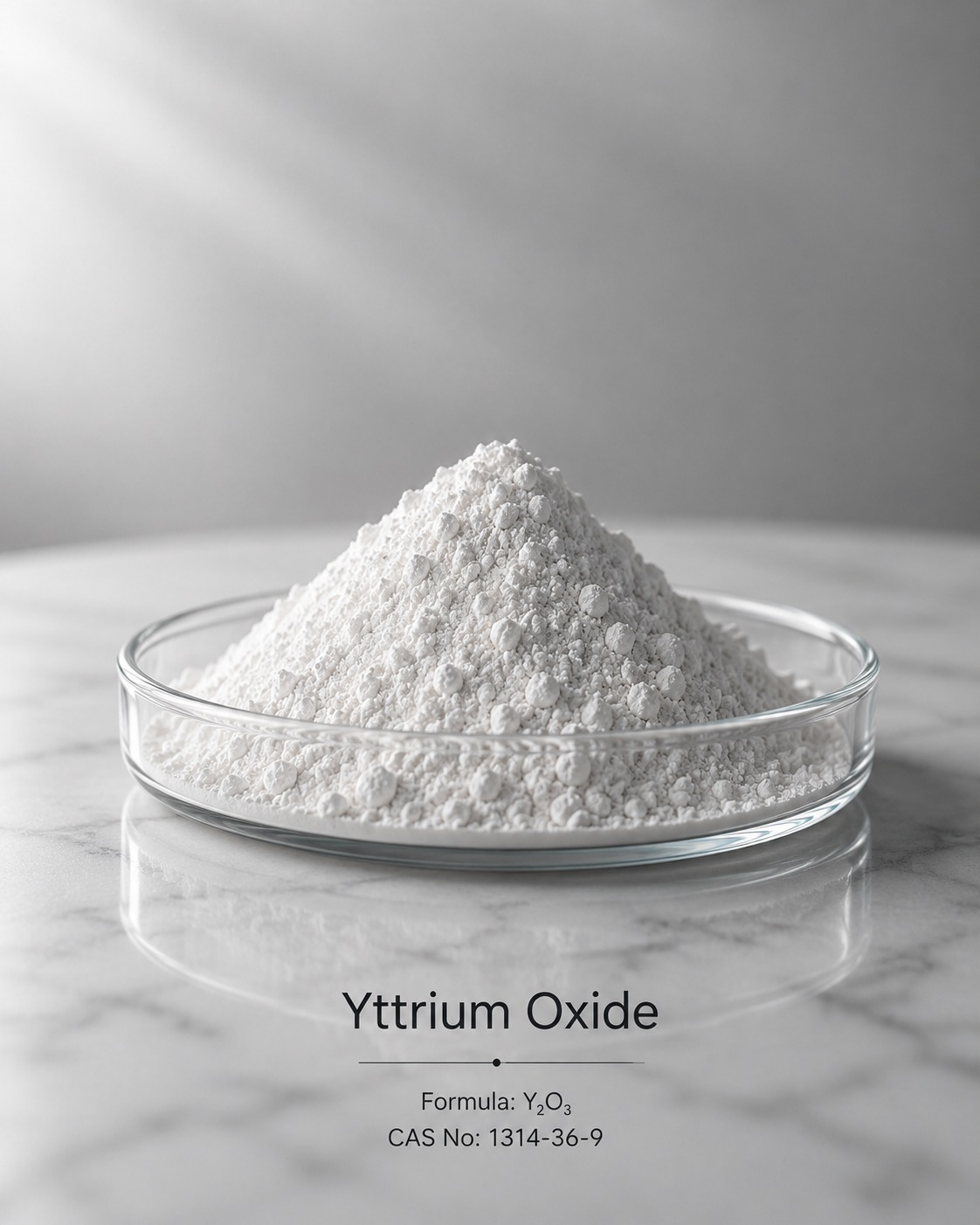
- CAS number: verify identity as yttrium oxide CAS 1314-36-9.
- Appearance: a white powder is expected.
- Powder characteristics: particle size distribution and related properties.
- Particle-size requirements: state explicitly where the process is sensitive.
- Packaging: bags, drums, or customised bulk packaging.
- Quantity: from lab-scale to bulk industrial orders.
- Documentation: specification sheet and technical data.
- Certificate of Analysis: lot-specific confirmation of what you receive.
- Application requirements: that the material suits the intended use.
- Supply continuity: ability to support repeat orders.
- Shipping requirements: logistics to your delivery location.
- Custom specifications: any application-specific needs agreed in advance.
Yttrium Oxide Specification Checklist for Buyers
Verified product values from Neugen Labs appear where applicable. For anything application-dependent, confirm the current specification, technical data, or Certificate of Analysis against the Yttrium Oxide specifications with the supplier.
| Specification | What to Check | Why It Matters |
|---|---|---|
| Chemical name | Yttrium Oxide (yttria) | Confirms the correct material family |
| Chemical formula | Y₂O₃ | Distinguishes it from other yttrium compounds |
| CAS number | 1314-36-9 | Verifies precise material identity |
| Purity | Listed product purity: 99.999% | Sets the impurity ceiling; align with the application |
| TREO | Listed: 99.601% | Total rare earth oxide content for rare earth oxide materials |
| Appearance | White powder | A quick visual identity and quality indicator |
| Powder characteristics | Confirm with supplier for your process | Affects processing and downstream behaviour |
| Packaging | Bags, drums, or customised bulk packaging | Matches handling, storage, and order size |
| Documentation | Request specification sheet and Certificate of Analysis | Provides lot-level assurance and traceability |
| Application-specific requirements | Confirm with supplier | Ensures grade and format fit the intended use |
How Yttrium Oxide Price Should Be Evaluated
There is no single fixed yttrium oxide price, and a responsible supplier will not quote one out of context. Cost can vary with purity grade, quantity, packaging, custom requirements, prevailing market conditions, supply availability, logistics, and documentation requirements. A higher grade, a small lab-scale lot, or bespoke packaging each move the figure differently.
Because these factors interact, the most accurate way to understand price is to request a quotation built around your actual needs. Buyers who provide their required purity, quantity, packaging, and application requirements receive a relevant quote, and can compare suppliers on a like-for-like basis rather than on a headline number alone.
How to Evaluate Yttrium Oxide Suppliers in USA
When comparing yttrium oxide suppliers in USA markets, price is only one line in a larger picture. A supplier that offers clear documentation and dependable supply can save far more than a marginally lower unit cost. Industrial buyers can assess a supplier on:
- Product specifications: clearly stated and verifiable.
- Purity consistency: reliable performance across lots.
- Documentation: specification sheets and technical data.
- Certificate of Analysis availability: lot-level assurance on request.
- Packaging options: formats suited to handling and order size.
- Bulk supply capability: ability to scale with demand.
- Custom requirements: flexibility on application-specific needs.
- Communication: responsiveness and clarity.
- Logistics: dependable shipping across the USA.
- Supply continuity: support for repeat orders over time.
- Technical support: help turning requirements into a specification.
- Commercial transparency: clear, context-based quotations.
Evaluating the complete supply proposition, quality, documentation, continuity, and support together, gives a more accurate view than choosing by price alone, particularly for a high-purity yttrium oxide supplier serving demanding applications. As a result, buyers who shortlist yttrium oxide suppliers in USA markets on these combined criteria tend to secure more reliable long-term supply. In short, the lowest quoted figure rarely tells the whole story.
Yttrium Oxide Supplier vs Manufacturer: What Should Buyers Know?
The terms are sometimes used loosely, but they describe different roles. A yttrium oxide manufacturer produces the material, while a yttrium oxide supplier or distributor sources and supplies it. Neither role is inherently better, what matters is what each can verify for your order.
Whichever you engage, confirm the essentials rather than assuming: the source of the material, who owns the specification, traceability and documentation, availability and lead time, packaging options, technical support, and supply capacity. When a company describes itself as a manufacturer, it is fair to ask it to state that plainly and to back it up with documentation. Focusing on these verifiable points keeps the comparison grounded regardless of the label a company uses.
Buying Yttrium Oxide in Bulk or Wholesale Quantities
Buying at scale changes the questions worth asking. Companies looking for yttrium oxide bulk / wholesale quantities should weigh not only unit cost but the practicalities of larger, repeated orders:
- Quantity requirements: current demand and realistic forecast.
- Packaging: bulk formats and customised packaging.
- Storage: safe handling and storage of larger volumes.
- Shipping: logistics to your location.
- Supply continuity: dependable availability over time.
- Batch consistency: lot-to-lot uniformity.
- Documentation: consistent specification and Certificate of Analysis per lot.
- Purchase frequency: one-off versus scheduled supply.
- Custom packaging: formats matched to your process.
- Scheduled supply: arrangements that align with production.
These requirements are best discussed with the supplier before ordering, so that quantity, packaging, and timing are agreed rather than assumed.
Yttrium Oxide for Sale: What Should You Confirm Before Ordering?
When you find yttrium oxide for sale, treat the listing as a starting point for verification. This short checklist helps procurement teams turn an inquiry into a well-defined order:
- Required purity: the grade your application actually needs.
- Application: the intended use and its sensitivities.
- Quantity: lab-scale, bulk, or scheduled supply.
- Packaging: formats suited to handling and storage.
- Required documentation: specification sheet and Certificate of Analysis.
- Delivery destination: where the material must ship.
- Special specifications: any custom or application-specific needs.
- Quote requirements: the details a supplier needs to quote accurately.
Yttrium Oxide CAS 1314-36-9: Product Identification
A CAS number removes ambiguity when requesting quotations, specifications, and procurement documentation, it identifies the exact substance regardless of trade names or wording. For yttria, the key identifiers are:
Quoting yttrium oxide CAS 1314-36-9 on purchase orders and inquiries helps ensure that everyone in the supply chain is referring to the same material, which reduces the risk of receiving a related but different yttrium compound.
Why Consider Neugen Labs for Yttrium Oxide Supply?
Neugen Labs offers USA-based supply of high-purity yttrium oxide, with a product listed at 99.999% purity and a TREO of 99.601%, supplied as a white powder for industrial applications such as advanced ceramics, electronics and semiconductor-related uses, thermal barrier coatings, optical and laser materials, metallurgy and alloys, and specialty manufacturing.
Supply options include lab-scale quantities through to bulk industrial orders, with packaging available in bags, drums, or customised bulk formats, plus supply support across the USA and customer support for product requirements. For exact specifications tied to a given grade or application, confirm the current product specification or Certificate of Analysis directly. You can review full details on the Yttrium Oxide product page.
8-Step Yttrium Oxide Procurement Process
Define Your Application
Clarify the intended use, which drives every later decision.
Determine Required Purity
Identify whether 3N, 4N, or 5N fits, not just the highest available.
Review Impurity Requirements
Establish which trace elements matter and any limits that apply.
Confirm Quantity and Packaging
Match order size and packaging to handling and storage.
Request Technical Documentation
Ask for the specification sheet and a Certificate of Analysis.
Compare Suppliers
Weigh quality, transparency, continuity, and support across options.
Confirm Logistics
Agree shipping arrangements to your delivery location.
Request a Quote
Provide your details and finalise the supply arrangement.
Frequently Asked Questions About Yttrium Oxide
Purity and Grade Questions
Yttria is commonly offered at 99.9% (3N), 99.99% (4N), and 99.999% (5N). Higher grades have lower total impurity content. The appropriate grade depends on your application and its impurity sensitivity, so review the specification alongside the percentage.
99.9% is a 3N grade and 99.99% is a 4N grade; the 4N material has a lower total impurity content. Which is suitable depends on how sensitive your process is to specific trace elements, so confirm the impurity profile before deciding.
5N refers to 99.999% purity, "5N" counts the five nines. It is a high-purity yttria grade often associated with impurity-sensitive applications, though whether it is the right choice depends on the specific process.
Not automatically. A higher grade reduces impurity content, but "better" depends on whether your application is sensitive to those impurities. Specifying more purity than a process needs can add cost without benefit, so match the grade to the requirement.
Buying and Yttrium Oxide Suppliers in USA Questions
Price can vary with purity grade, quantity, packaging, custom requirements, market conditions, supply availability, logistics, and documentation needs. The most accurate figure comes from a quotation based on your required purity, quantity, packaging, and application.
Ask about purity and impurity profile, formula and CAS number, powder characteristics, packaging and quantity options, documentation such as a Certificate of Analysis, supply continuity, logistics, and technical support, and request a context-based quote.
Yes, options typically range from lab-scale quantities to bulk industrial orders, with bags, drums, or customised bulk packaging and scheduled supply arrangements. Confirm quantity, packaging, and timeline with the supplier before ordering.
Look for a US-based supplier that offers clear specifications, purity documentation and Certificate of Analysis availability, suitable packaging and bulk supply, dependable logistics, and responsive technical support. Neugen Labs provides high-purity Y₂O₃ supply across the USA.
Looking for a Reliable Yttrium Oxide Supplier in the USA?
Tell Neugen Labs your required purity, quantity, packaging, and application requirements to discuss the appropriate Y₂O₃ supply option.