Antimony Trioxide for Flame Retardant Applications in the USA: Purity, Performance, and Sourcing Guide
Antimony Trioxide for Flame Retardant Applications in the USA: Purity, Performance, and Sourcing Guide
Antimony trioxide is one of the most widely specified inorganic additives in flame-retardant formulation work, and it is rarely bought on price alone. Buyers sourcing antimony trioxide in the USA usually arrive with a defined polymer system, a target fire-performance rating, and a set of processing constraints, then work backwards to the grade of antimony oxide that will hold those results steady across production lots.
The material behaves as a synergist. On its own it contributes little flame retardancy in most polymers, but paired with a compatible halogen-containing system it can meaningfully improve fire performance at loadings that keep mechanical and aesthetic properties intact. That relationship is what makes specification detail, impurity data, and lot consistency so important during sourcing.
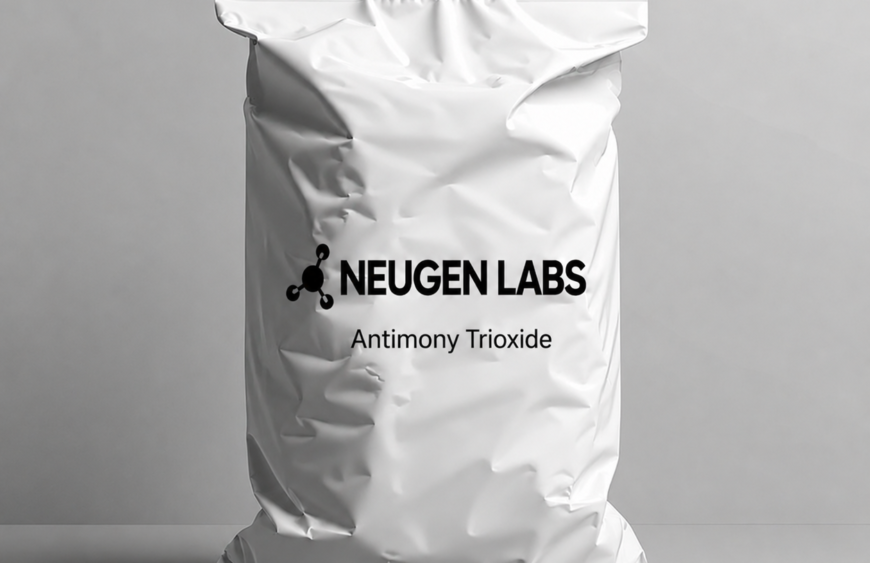
Neugen Labs supplies antimony trioxide at 99.9% Sb2O3 minimum assay, which corresponds to 3N in purity-grade shorthand, as a white free-flowing crystalline powder at 325 mesh, available from US stock in 25 kg bags and 1000 kg big bags. Full details are on the antimony trioxide product page. This guide covers chemical identity, the mechanism behind synergistic performance, application areas, the specification points procurement teams should verify, and how to evaluate a domestic supplier before placing an order.
What Is Antimony Trioxide?
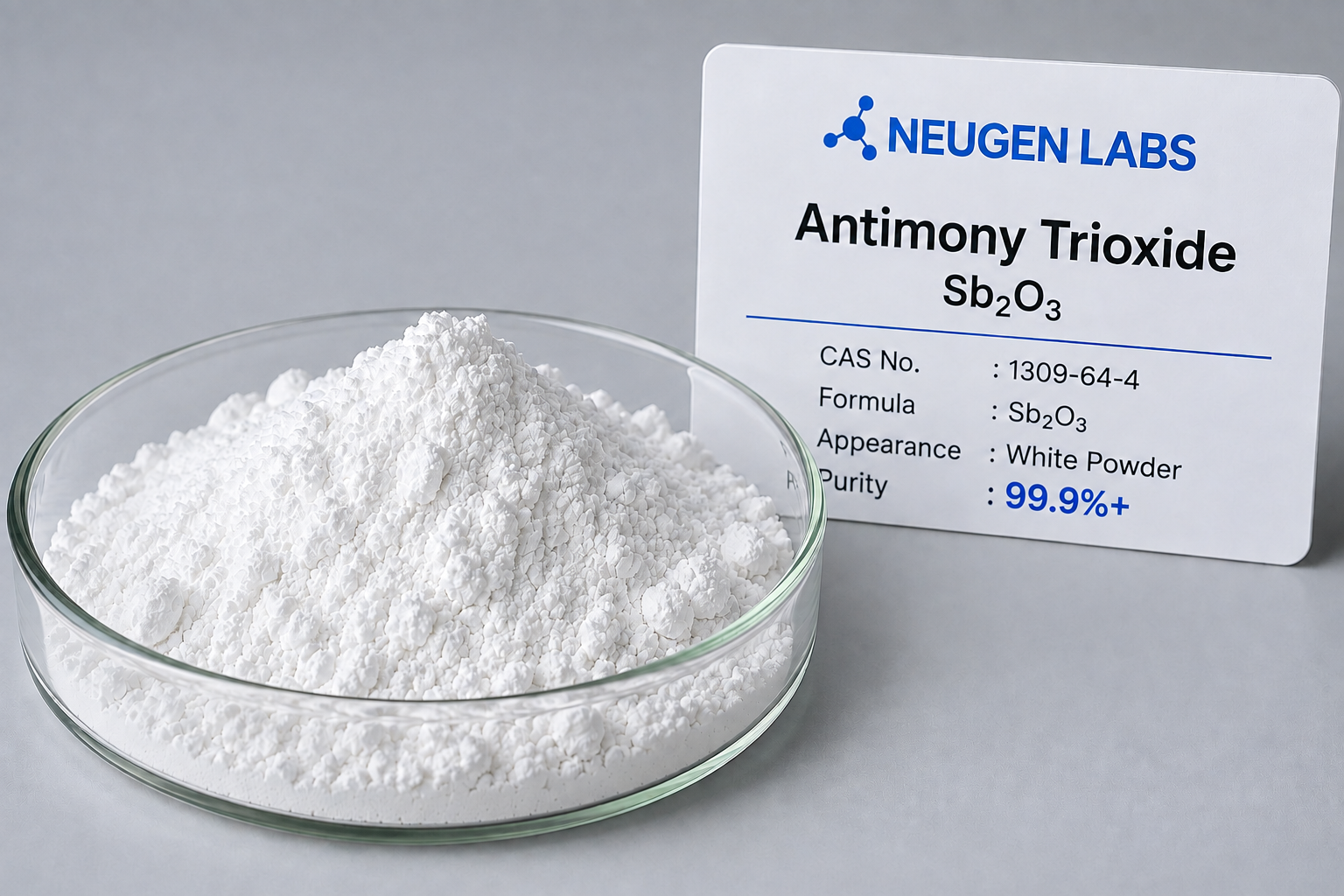
Antimony trioxide, also written as antimony(III) oxide, is the inorganic compound Sb2O3. It is the most commercially significant oxide of antimony and reaches industry mainly as a fine white powder produced for use as an additive rather than as a finished product.
Key identity and property points:
- Chemical name: antimony(III) oxide, commonly called antimony trioxide or antimony oxide
- Formula: Sb2O3
- CAS number: 1309-64-4
- Molar mass: approximately 291.5 g/mol
- Appearance: white to off-white crystalline powder
- Crystal forms: cubic (senarmontite) and orthorhombic (valentinite) polymorphs are both recognised
- Solubility: essentially insoluble in water; soluble in concentrated acids and strong alkali
- Thermal behaviour: a stable, high-melting solid under normal processing conditions
Commercial relevance comes from how the compound behaves inside a formulation rather than from any single bulk property. Because it is inert in water and stable through typical compounding temperatures, Sb2O3 can be dispersed into polymers, coatings, and textile finishes without breaking down before it is needed. Colour, particle size distribution, and trace metal content vary between grades, and those variables are usually what separate one supplier's material from another's.
Why Is Antimony Trioxide Used in Flame Retardant Systems?
Antimony oxide is best understood as a performance multiplier for halogenated flame retardants. Used alone in most polymers, it does not deliver the fire performance that formulators are targeting. Combined with a compatible brominated or chlorinated flame retardant, it can lift the same system to a higher rating without a proportional increase in total additive loading.
The accepted explanation centres on gas-phase chemistry. During thermal decomposition, the halogen source releases hydrogen halide, which reacts with the antimony oxide to form volatile antimony halide and oxyhalide species. Those species migrate into the flame zone, where they interfere with the highly reactive hydrogen and hydroxyl radicals that sustain combustion. Slowing that radical chain reduces the energy feeding back into the polymer surface, which in turn slows further decomposition.
Several practical consequences follow from that mechanism:
- A halogen source is required. Without a compatible halogenated flame retardant present, the synergistic pathway does not operate as intended.
- Ratio matters. The relationship between halogen content and antimony loading is a formulation variable, and the optimum differs by polymer and by target standard.
- Dispersion affects results. Agglomerated material distributed unevenly through a compound will not perform like well-dispersed powder at the same loading.
- Performance is system-level. Fire test results depend on the polymer, the halogen source, fillers, processing history, and part geometry together.
For this reason, formulators normally validate flame-retardant packages by testing the actual formulation against the applicable standard. Supplier data on a single component supports that work but does not replace it, and results from one polymer system rarely carry across to another.
Applications of Antimony Trioxide
The categories below cover the main end uses for antimony trioxide in the USA and elsewhere. Grade requirements differ considerably between them, so these should be read as general use areas rather than as fixed specifications.
Plastics and Polymers
Compounded into thermoplastics and thermosets as part of an additive package, where dispersion quality and thermal stability during processing both matter.
Flame Retardant Systems
Paired with halogenated flame retardants to improve fire performance, with loading set by the polymer and the target standard.
Textiles and Coatings
Formulators add it to back-coatings and treated fabrics that need a durable finish and consistent particle characteristics.
Electrical and Electronic Materials
Used in housings, connectors, and insulation compounds where fire-performance requirements sit alongside strict dimensional and electrical demands.
Rubber and Specialty Materials
Formulated into elastomer compounds and cable jacketing, where compatibility with the base polymer governs the final result.
Industrial Formulations and R&D
Applied in development work, pilot batches, and reformulation trials, where a documented impurity profile supports reproducible results.
Beyond flame retardancy, antimony oxide appears in other roles such as an opacifying agent in glass, ceramics, and enamels, and as a catalyst component in certain polyester manufacturing routes. Those uses call for different specifications again, so buyers should confirm the intended function with the supplier rather than assume that one grade transfers across applications.
Why Purity Matters for Industrial Applications
What Purity Actually Covers
Purity in this context means more than a headline assay figure. Two lots can carry the same nominal Sb2O3 content and still behave differently in a compound because of what accompanies the antimony and how the particles are distributed.
- Trace impurities can shift performance. Residual metals and other contaminants may affect colour, thermal stability during processing, or long-term ageing behaviour in the finished part.
- Colour and whiteness are commercially relevant. In light-coloured or pigmented articles, an off-specification lot can force reformulation or rejection even when fire performance is unaffected.
- Particle characteristics influence dispersion. Size distribution and agglomeration govern how evenly the polymer melt carries the additive, which feeds directly into performance at a given loading.
- Batch-to-batch consistency protects production. Formulations validated against a fire standard depend on incoming material behaving the same way each time.
- Documentation makes verification possible. A Certificate of Analysis allows an incoming-goods check against the agreed specification instead of reliance on general assurances.
Required purity is application dependent. Some compounding operations work comfortably with industrial-grade material, while colour-critical or highly regulated applications justify a tighter specification. The practical approach is to define what the application actually needs, then confirm that the offered grade meets it in writing.
Reading the N Grade Notation
Purity grades are sometimes written in the "N" shorthand, where the number counts the leading nines in the assay figure. On that scale, 99.5% becomes 2N5, 99.9% becomes 3N, and 99.99% becomes 4N. The notation gives a convenient label rather than a full specification, since it says nothing about moisture, particle size, or which trace elements the producer controls. Two materials sharing an N grade can still differ in the impurities that matter to a given formulation.
Neugen Labs guarantees a minimum assay of 99.9% Sb2O3, or 3N, on current production. Moisture sits at 0.1% maximum, arsenic trioxide typically falls below 0.03%, and the powder ships at 325 mesh with excellent whiteness. Arsenic limits matter in colour-sensitive and closely regulated end uses, so confirm the current specification against your own acceptance criteria before ordering.
Key Specifications to Consider When Buying Antimony Oxide
The table below sets out the specification points worth confirming before an order is placed. Check any value marked as a confirmation item against the current product specification for the grade quoted.
| Property | What Buyers Should Check |
|---|---|
| Chemical identity | Antimony(III) oxide, supplied as the trioxide rather than a mixed or higher oxide |
| Formula | Sb2O3 |
| CAS number | 1309-64-4 |
| Purity / assay | Neugen Labs guarantees 99.9% Sb2O3 minimum (3N); confirm the guaranteed figure against your specification |
| Appearance | White free-flowing crystalline powder with excellent whiteness; confirm colour requirements for colour-sensitive end products |
| Particle characteristics | Supplied at 325 mesh; confirm that this suits your dispersion method and compounding process |
| Packaging | 25 kg bags or 1000 kg big bags; confirm which format suits your handling and storage arrangements |
| Certificate of Analysis | Request lot-specific documentation and confirm which parameters are reported |
| Trace impurity profile | Arsenic (As2O3) typically below 0.03%; confirm the guaranteed limit and any other elements relevant to your application |
| Batch consistency | Ask how lot-to-lot variation is controlled and whether historical data is available |
| Availability | Available from US stock; confirm current availability for your quantity and order cadence |
| Documentation | Confirm that the current SDS and any required regulatory or transport documentation are supplied |
Antimony Oxide for Different Industrial Applications
Procurement priorities shift with the end use. Buyers of antimony trioxide in the USA weigh the same material differently depending on where it ends up, as the comparison below shows.
| Application | Typical Role | Key Buying Consideration |
|---|---|---|
| Engineering plastics | Synergist within a halogenated flame-retardant package | Dispersion behaviour and lot-to-lot consistency |
| Wire and cable compounds | Contributor to fire performance in insulation and jacketing | Particle characteristics and processing stability |
| Textile back-coatings | Component of a flame-retardant finish system | Particle size and finish durability requirements |
| Paints and coatings | Additive supporting fire performance and opacity | Colour, whiteness, and dispersion quality |
| Electrical and electronic housings | Part of the additive package meeting fire-safety requirements | Documented specification and regulatory information |
| Rubber and elastomers | Formulation additive in compounded systems | Compatibility with the base polymer and cure system |
| Research and formulation development | Reference input for trials and reformulation | Impurity documentation and reproducibility |
How to Choose a Supplier of Antimony Trioxide in the USA
Sourcing antimony trioxide in the USA tends to be driven by technical fit and supply reliability rather than headline pricing. A quotation that omits specification detail is difficult to compare against one that includes it, so the first task is usually to get every offer onto the same basis.
Points worth weighing when comparing US suppliers:
- Specification clarity: a written product specification that states what is guaranteed and what is typical.
- Impurity reporting: visibility of the trace elements that matter to your formulation.
- Consistency: evidence that the supplier can hold the same specification across repeat orders.
- Documentation: Certificate of Analysis and current Safety Data Sheet available where applicable.
- Packaging and quantity flexibility: pack formats suited to trial quantities as well as ongoing production needs.
- Domestic sourcing: material held in US stock simplifies procurement and reduces reliance on longer international lead times.
- Technical communication: a supplier able to discuss specification questions directly, rather than only quoting on a part number.
Neugen Labs works with US buyers sourcing specialty chemicals for industrial, formulation, and research requirements, supplying antimony oxide at 99.9% minimum assay from US stock, with clear product documentation and direct technical communication. To understand the wider scope of what the company handles, explore specialty chemical sourcing services or learn more about Neugen Labs. To discuss a specific requirement, contact the Neugen Labs team.
How to Evaluate a Specialty Chemical Supplier
The sequence below gives procurement teams a repeatable way to move from an application requirement to a comparable quotation.
- Define the application, the polymer or substrate involved, and the fire-performance standard you are working toward.
- Establish the purity level the application genuinely requires, rather than defaulting to the highest available grade.
- Confirm the full material specification in writing, including the assay basis and stated tolerances.
- Identify the trace impurities relevant to your process and confirm they appear on the reported analysis.
- Determine quantity, order cadence, and packaging that suit your handling and storage arrangements.
- Request the Certificate of Analysis and review it against your incoming-goods criteria.
- Confirm current availability, delivery requirements, and any transport documentation needed for your site.
- Request a formal quotation so you can compare offers on equivalent technical terms.
Why Choose Neugen Labs for Specialty Chemical Sourcing?
99.9% / 3N Minimum Assay
Antimony trioxide supplied at 99.9% Sb2O3 minimum assay, as a white free-flowing powder with excellent whiteness.
Product Documentation
Applicable product specifications and Certificate of Analysis provided where relevant to the material supplied.
Application-Focused Discussion
We review requirements in the context of the intended use, so the grade discussed reflects the actual application.
US Stock
Material available from US inventory, which supports domestic procurement and reduces dependence on international shipping timelines.
Practical Packaging Options
Supplied in 25 kg bags or 1000 kg big bags, with a minimum order quantity of 1 MT for commercial requirements.
Responsive Communication
Direct answers on specification, quantity, and documentation questions during the enquiry stage.
The Neugen Labs technical resources section covers related materials and sourcing topics.
Antimony Trioxide Specifications and Buyer Checklist
Use the checklist below when preparing an enquiry for antimony trioxide in the USA. Completing it before contacting a supplier usually shortens the quotation cycle considerably.
| Checklist Item | Detail to Confirm |
|---|---|
| Chemical name | Antimony(III) oxide / antimony trioxide |
| Chemical formula | Sb2O3 |
| CAS number | 1309-64-4 |
| Purity requirement | 99.9% Sb2O3 minimum guaranteed (3N). State the grade your application requires |
| Physical form | White free-flowing crystalline powder, excellent whiteness |
| Particle characteristics | 325 mesh; moisture 0.1% maximum; As2O3 typically below 0.03% |
| Packaging | 25 kg bags or 1000 kg big bags |
| Quantity | Minimum order quantity 1 MT; state repeat or annual volume requirement |
| Certificate of Analysis | Request lot-specific documentation |
| Safety Data Sheet | Request the current SDS for the specific grade supplied |
| Availability | US stock. Confirm current availability for your quantity |
| Shipping requirements | Confirm delivery location and any site-specific documentation needs |
Current product details, specifications, and ordering information are listed on the antimony trioxide product page. For quantities, documentation, or application questions not covered there, contact the Neugen Labs team.
Take handling, exposure control, and workplace safety requirements from the current Safety Data Sheet for the specific grade supplied, together with the applicable federal and state regulations for your site. General occupational chemical information is also published by US federal agencies such as OSHA and NIOSH. Buyers should confirm the current regulatory position applicable to their jurisdiction and end use.
Frequently Asked Questions
What is antimony trioxide?
Antimony trioxide is the inorganic compound antimony(III) oxide, formula Sb2O3, CAS 1309-64-4. Industry receives it as a white to off-white powder that resists water and stays stable through normal compounding temperatures. Its main commercial role is as an additive within flame-retardant formulations, though it also serves other industrial functions.
What is the chemical formula of antimony oxide?
The formula is Sb2O3, corresponding to the trivalent oxide of antimony. Its CAS registry number is 1309-64-4 and its molar mass is approximately 291.5 g/mol. Higher oxides of antimony exist, so purchase documents should confirm the trioxide specifically.
Why is antimony trioxide used in flame retardant systems?
It functions as a synergist alongside halogenated flame retardants. During thermal decomposition it reacts with released hydrogen halide to form volatile antimony halide species that interfere with the radical reactions sustaining a flame. The effect depends on having a compatible halogen source present, so it is not usually treated as a standalone flame retardant.
Does antimony oxide work as a flame retardant on its own?
In most polymer systems, no. The recognised mechanism requires a halogen source in the formulation for the synergistic effect to operate. Used alone, the oxide behaves largely as an inert filler in many polymers. Always validate performance by testing the complete formulation against the relevant standard.
Purity, Grades and Supply
Which industries use antimony oxide?
Common users include plastics compounders, wire and cable manufacturers, textile finishers, coatings formulators, rubber compounders, and electrical and electronic component producers. It also appears in glass and ceramic opacifying applications and in certain polyester production routes. Grade requirements differ substantially between these areas.
How important is purity when sourcing this material?
It depends on the application. Trace metals can affect colour, thermal stability during processing, and ageing behaviour in the finished article. Neugen Labs guarantees 99.9% Sb2O3 minimum, a 3N grade, with arsenic trioxide typically below 0.03%. Colour-sensitive and closely regulated applications should also confirm the reported arsenic limit against their acceptance criteria.
What does 3N purity mean for antimony oxide?
The N shorthand counts the leading nines in an assay figure, so 2N5 means 99.5%, 3N means 99.9%, and 4N means 99.99%. Material supplied at 99.9% Sb2O3 minimum is therefore a 3N grade. The label alone says nothing about moisture, particle size, or trace element limits, so always review the full specification.
Buying and Documentation
What purity and packaging is antimony trioxide supplied in?
Neugen Labs guarantees 99.9% Sb2O3 minimum (3N), supplies a white crystalline powder at 325 mesh, and holds moisture at 0.1% maximum. Packing options cover 25 kg bags or 1000 kg big bags, with a minimum order quantity of 1 MT. Request the Certificate of Analysis and current Safety Data Sheet for the lot supplied.
Where can buyers source antimony trioxide in the USA?
Several specialty chemical suppliers serve the US market. Neugen Labs supplies antimony trioxide at 99.9% minimum assay from US stock, in 25 kg bags or 1000 kg big bags, with a minimum order quantity of 1 MT. The antimony trioxide product page lists full details, and you can request a quotation with your specification, quantity, and application details.
Need Antimony Oxide for Your Industrial Application?
Antimony trioxide at 99.9% minimum assay, available from US stock in 25 kg bags and 1000 kg big bags. Tell us the specification, quantity, application, and documentation your site requires, and the Neugen Labs team will respond with a quotation.