Ammonium Paratungstate, almost always shortened to APT, is the single most important intermediate in the entire tungsten industry. In fact, nearly every tungsten product you can name, from the carbide tip on a drill bit to the filament heritage of the lighting industry, traces back to APT. Therefore, this guide explains what APT is, the chemistry that makes it so central, its main industrial uses, and finally why its supply matters as a strategic concern for buyers in the United States.
If you already know what you need, you can view full specifications and request pricing on our Ammonium Paratungstate (APT) product page.
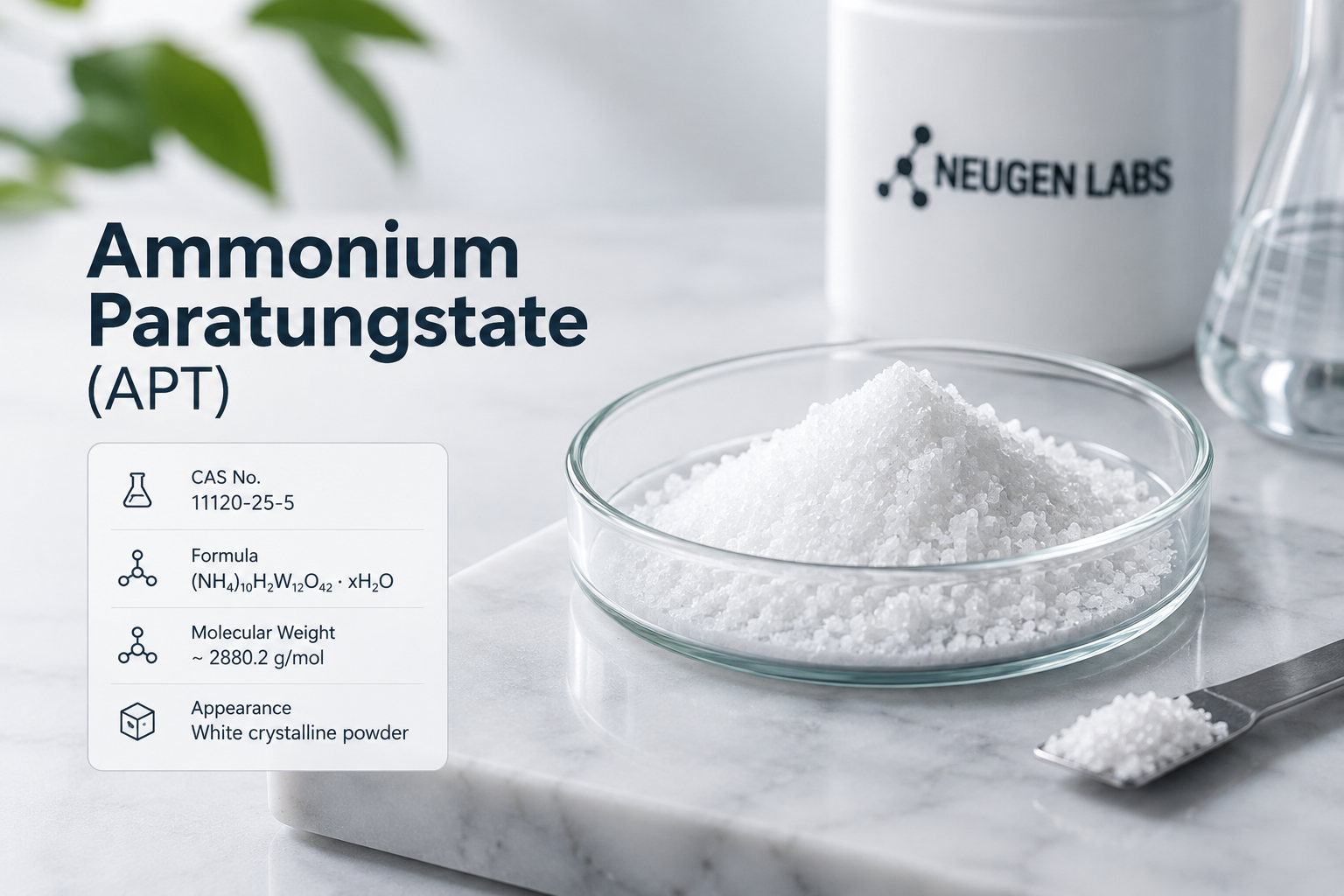
What Is Ammonium Paratungstate?
Ammonium Paratungstate is the crystalline ammonium salt of paratungstic acid, and it serves as the central intermediate that refiners produce from tungsten ores. The technical literature describes it as the most important raw material for all other tungsten products. First, refiners digest tungsten ores, which are typically oxide minerals such as wolframite and scheelite, in a base to give tungstate solutions along with many contaminating species. Next, they purify and acidify that crude extract until APT crystallizes out, and as a result the process delivers a high purity intermediate that separates the tungsten from most of its original impurities.
Because the purity of the starting APT largely governs the purity of every downstream tungsten product, trace metal control at this stage becomes critical for demanding applications such as cutting tools, sputtering targets and aerospace alloys. Consequently, buyers care a great deal about assay and impurity limits when they qualify an APT source.
The Chemistry: How APT Becomes Tungsten
APT matters because of what it turns into. When you heat it in a controlled way to its decomposition temperature of about 600 °C, APT breaks down to tungsten trioxide (WO3) and releases ammonia and water. The idealized reaction below shows this step:
Next, a hydrogen atmosphere heats the tungsten trioxide and reduces it to metallic tungsten powder:
This two step route, APT to oxide to metal, forms the backbone of tungsten powder metallurgy. Moreover, the calcination conditions shape the result: under oxidizing conditions the intermediate oxide becomes yellow tungsten oxide (WO3), while under reducing conditions it becomes blue tungsten oxide (often written TBO). APT yields both forms, and both then feed into tungsten powder production. You can see the oxide stage of this chain on our Tungsten Oxide product page.
Here is a point of technical interest for specifiers: the anion in APT is the paratungstate B ion, [H2W12O42]10−. For this reason, the correct formula reads (NH4)10[H2W12O42]·xH2O rather than a simpler tungstate. In practice, the tetrahydrate is the commercially significant form, although the literature also documents penta, hexa, nona and decahydrate forms.
Physical and Chemical Properties of APT
APT is a white crystalline powder that dissolves only slightly in cold water and stays insoluble in alcohol. It also stays stable under normal room temperature storage, and it decomposes on heating to yield tungsten trioxide. Furthermore, its controlled crystal morphology gives good flowability for precise dosing, while its predictable decomposition behaviour supports uniform conversion into tungsten oxides and, ultimately, tungsten metal and carbide.
Swipe table sideways to see all columns →
| Property | Detail |
|---|---|
| Chemical Name | Ammonium Paratungstate (APT) |
| CAS Number | 11120-25-5 |
| Formula | (NH4)10[H2W12O42]·xH2O |
| Appearance | White, free flowing crystalline powder |
| Solubility | Slightly soluble in cold water, insoluble in alcohol |
| Decomposition | Around 600 °C, yielding tungsten trioxide |
| Neugen Labs Assay | 99.54% |
| Tungsten Content | 70.11% |
| Order Quantity | Bulk quantity available |
Note: the assay, tungsten content and impurity limits shown reflect Neugen Labs' typical specification, and Neugen Labs provides a batch specific Certificate of Analysis (COA) on request.
Uses & Industrial Applications of APT
APT serves as the starting point for most of the tungsten supply chain. Accordingly, the sections below outline the main application areas.
Industries That Depend on APT
According to the US Geological Survey, roughly 60% of the tungsten that the United States consumes goes into cemented carbide parts for cutting and wear resistant applications, primarily in construction, metalworking, mining and oil and gas drilling. Meanwhile, the remainder supports alloys and specialty steels, electrodes, filaments and wires, and a range of tungsten chemicals. Because APT sits at the head of that chain, it ultimately reaches every one of these industries.
APT Supply and Why USA Sourcing Matters
Tungsten supply stays unusually concentrated. The US Geological Survey reports that production in and exports from China dominate world tungsten supply, and that the United States has not mined tungsten commercially in recent years, which leaves domestic industry dependent on imports and recycled scrap. Furthermore, only a small number of US companies, around seven per the USGS, can convert concentrates, APT, tungsten oxide or scrap into finished tungsten powders, carbide powders and chemicals.
For a buyer, that concentration is exactly why a reliable, documented APT source matters. Specifically, lead times, import exposure and consistency of grade all affect downstream yield. As a result, sourcing from a US based supplier with batch specific documentation, and with bulk quantity available, reduces the friction of qualifying material and helps protect production schedules against import disruption.
Neugen Labs is a USA based APT manufacturer and supplier serving powder producers, carbide manufacturers and distributors, with nationwide delivery, bulk quantity availability and a batch specific COA available on request. View the APT product page for current specifications.
How to Choose an APT Supplier
When you qualify an Ammonium Paratungstate source, compare suppliers on the factors that affect your yield and final tungsten quality. In particular, weigh the six points below:
APT vs AMT: What Is the Difference?
Ammonium Paratungstate (APT) and Ammonium Metatungstate (AMT) are related tungsten salts, but they are not interchangeable. Partial thermal decomposition of APT produces AMT, and the two differ most importantly in water solubility, which in turn drives how each one behaves in use.
Swipe table sideways to see all columns →
| Attribute | APT | AMT |
|---|---|---|
| CAS Number | 11120-25-5 | 12028-48-7 |
| Water Solubility | Low (slightly soluble) | High (very soluble) |
| Typical Use | Solid state tungsten powder & carbide production | Catalysts and solution based tungsten chemistry |
| Relationship | Primary refined tungsten intermediate | Produced by partial thermal decomposition of APT |
Frequently Asked Questions
What is Ammonium Paratungstate (APT)?
APT is a white crystalline ammonium salt of tungsten, and it serves as the primary refined intermediate for producing tungsten metal powder, tungsten carbide and tungsten oxides.
What is the CAS number and formula of APT?
The CAS number is 11120-25-5 and the formula is (NH4)10[H2W12O42]·xH2O, with a tungsten content of approximately 70.11%.
What temperature does APT decompose at?
APT decomposes at around 600 °C to form tungsten trioxide (WO3), and it releases ammonia and water. After that, hydrogen reduces the trioxide to metallic tungsten.
What is APT used for?
It mainly acts as the precursor for tungsten metal powder and tungsten carbide, and it also produces tungsten oxides, catalysts and advanced tungsten materials for electronics and aerospace.
What is the difference between APT and AMT?
APT (CAS 11120-25-5) dissolves only slightly in water and suits solid state tungsten powder and carbide production. In contrast, AMT (CAS 12028-48-7) dissolves readily in water; partial thermal decomposition of APT produces it, mainly for catalyst and solution based applications.
Where can I buy APT in the USA?
Neugen Labs is a USA based APT manufacturer and supplier with nationwide delivery, bulk quantity availability and batch specific COA on request. Visit the Ammonium Paratungstate product page to request a quote.
Need High Purity APT for Your Process?
Neugen Labs supplies high purity Ammonium Paratungstate (APT) across the USA in bulk quantity, with batch specific COA on request. So, to view full specifications and request pricing, head to the product page or email us for a quote.
This guide summarises general tungsten chemistry and mineralogy from established public references (Ullmann's Encyclopedia of Industrial Chemistry; Greenwood & Earnshaw, Chemistry of the Elements), and it draws supply and consumption context from the US Geological Survey, Mineral Commodity Summaries. Product specifications represent Neugen Labs' own typical values, and Neugen Labs provides a batch specific COA on request.