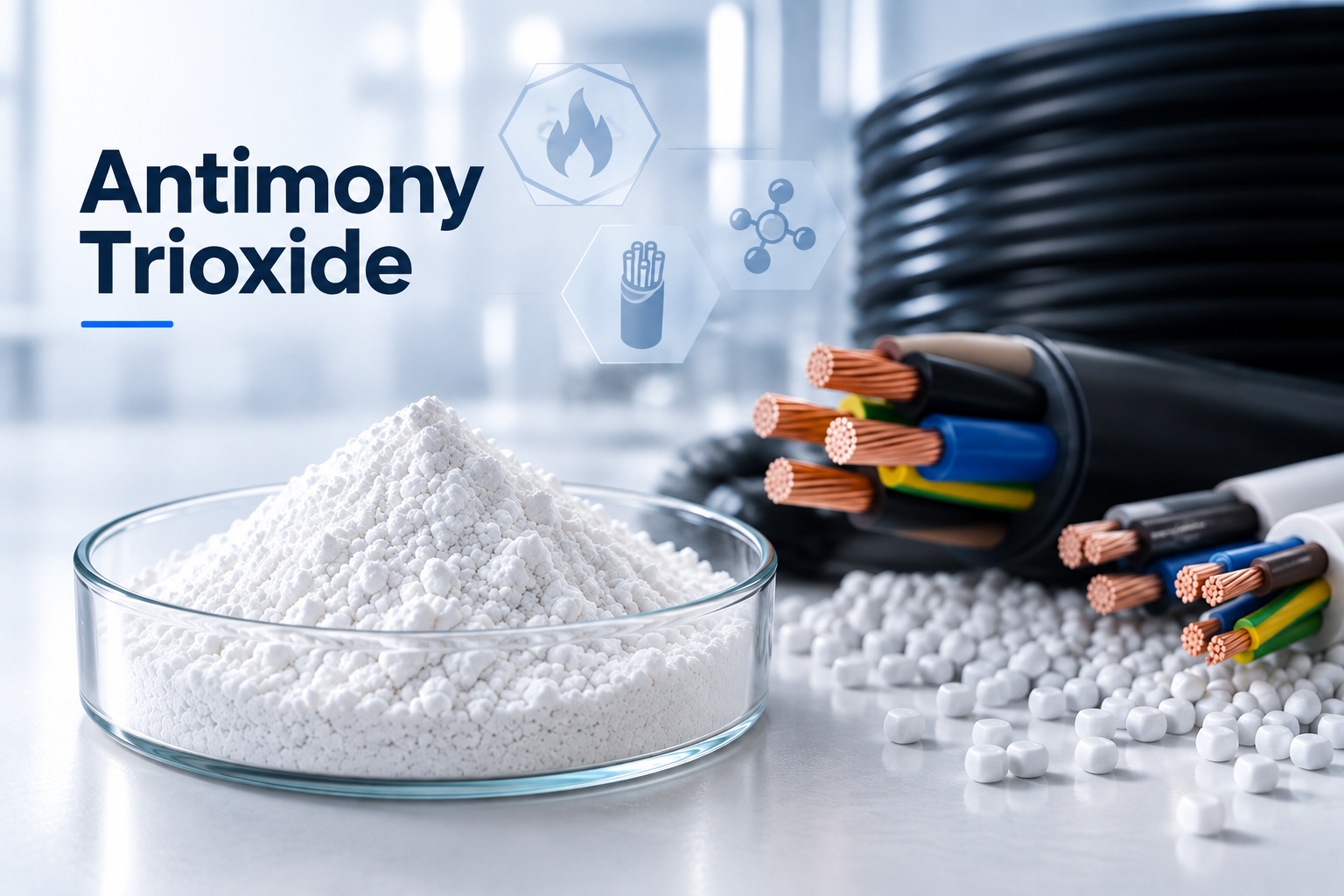
Cable and wire compounds face a specific engineering demand: they must resist ignition and slow flame propagation while retaining flexibility, extrudability and long-term electrical performance. In flame-retardant PVC formulations, Antimony Trioxide (Sb₂O₃) is the additive most compounders reach for to sharpen the fire performance of an existing halogen-based system.
PVC already contains chlorine, which gives it a degree of inherent flame resistance. But meeting the fire-performance targets expected of modern insulation and jacketing usually requires more, and this is where Antimony Trioxide earns its place. It does not act alone; it works as a synergist that amplifies the halogenated chemistry already present in the compound.
This guide looks past the general chemistry and into the part that matters on the shop floor: how Sb₂O₃ behaves inside a PVC matrix, why dispersion decides whether it performs, and what a technical buyer should specify when sourcing it for wire and cable production. For compounders sourcing in the United States, Neugen Labs supplies Antimony Trioxide at up to 99.9% purity with bulk US stock available for production volumes.
Why Antimony Trioxide Is Used in PVC Wire and Cable Compounds
Antimony Trioxide is used in PVC wire and cable compounds as a flame-retardant synergist that boosts the effectiveness of the compound's halogen-based chemistry. On its own, Sb₂O₃ contributes little flame retardancy; its value comes from how it interacts with chlorine and other halogenated additives during combustion.
PVC is a chlorinated polymer, so a source of halogen is inherently present in the matrix. When a compounder adds Antimony Trioxide, the two form an active pair: the antimony reacts with halogen species released as the polymer heats, producing volatile antimony halides that interfere with the combustion process. The practical result is that a formulator can reach a target fire-performance level using a more efficient, better-balanced additive package rather than relying on halogen loading alone.
Formulation Compatibility in Cable Compounds
Formulation compatibility is central. Antimony Trioxide has to sit within a system that already balances plasticizers, stabilizers, fillers and pigments. Because it influences both fire behavior and, through its loading and dispersion, the compound's processing and appearance, a formulator specifies it as part of the whole recipe rather than bolting it on. Wire and cable formulations, in particular, react sensitively to any additive that can disturb flexibility or extrusion consistency.
How Antimony Trioxide Functions in Flame-Retardant PVC
The synergy between Antimony Trioxide and the halogen in PVC plays out as the material heats toward combustion. As the polymer decomposes, it releases hydrogen chloride and other chlorine-containing species, and Antimony Trioxide then reacts with these to form antimony trihalides and oxyhalides.
These antimony halide species are volatile, so they move into the gas phase at the flame front, where they act on the chain reactions that sustain combustion and interrupt the supply of reactive radicals that propagate the flame. Some condensed-phase activity also occurs at the surface of the burning polymer; however, the gas-phase radical interference remains the effect most associated with the antimony-halogen pair. As a result, flame propagation slows and the compound becomes harder to keep alight once the ignition source is removed. The PubChem record for antimony trioxide summarizes its chemical identity and properties.
Antimony Trioxide in PVC Cable Insulation and Jacketing
Insulation and jacketing place different demands on a PVC compound, and the way a formulator specifies Antimony Trioxide reflects those differences.
PVC Cable Insulation
Insulation sits in direct contact with the conductor, so it must preserve dielectric performance while contributing to the cable's fire behavior. Here the priority is a clean, uniform compound, because dispersion has to stay consistent so electrical properties remain predictable along the length of the run and no agglomerates create weak points. A formulator therefore balances Antimony Trioxide loading against the insulation's flexibility and thermal requirements.
PVC Cable Jackets and Sheathing
The jacket is the outer layer and the first line of defense against ignition, abrasion and environmental exposure. Flame-retardant sheathing compounds often carry the heavier share of the fire-performance requirement; consequently, the antimony-halogen system in a jacket compound frequently runs more prominent than in the insulation beneath it. Surface appearance and extrusion smoothness matter here too, and both tie directly back to how well the compounder disperses the Sb₂O₃.
Industrial and Electrical Cable Compounds
Industrial power, control and communication cables cover a wide range of duty and fire-performance expectations. Because compounders engineer these compounds case by case, they choose the Antimony Trioxide specification, purity, particle characteristics and batch consistency to suit the target performance and the compounding line rather than applying a single fixed grade across all cable types.
Why Dispersion Matters in PVC Compounding
Dispersion determines whether Antimony Trioxide actually performs in the finished compound. A given loading only delivers its intended effect when the particles spread uniformly through the polymer matrix. Poorly dispersed material, however, behaves as if the compound held less synergist, and it creates localized variation the formulator never designed for.
The core problem is agglomeration. Fine powders like Sb₂O₃ tend to cluster, and clusters that survive compounding do two things at once. First, they leave regions of the compound under-served by synergist. Second, they act as discrete inclusions that can weaken mechanical behavior and surface quality. Uniform particle distribution, therefore, is what converts a specified loading into consistent, repeatable performance.
Dispersion During Mixing and Extrusion
Good dispersion also depends on how the additive and the polymer system interact during mixing, because the powder must wet out and break down under shear as the PVC fluxes. When a compounder controls dispersion, processing stays consistent from batch to batch, extrusion runs more smoothly, and the fire-performance and appearance of the finished cable become more predictable. When dispersion drifts, by contrast, the same formulation can produce variable results even though the recipe on paper never changed.
Particle Size and Antimony Trioxide Performance in PVC
Particle characteristics influence how easily Antimony Trioxide disperses and how it behaves during processing. Finer, well-controlled powder generally distributes more readily through the polymer and leaves fewer visible or mechanical inclusions, which is why particle size and distribution belong in the specification rather than as an afterthought.
Particle characteristics can affect dispersion, processing behavior, the surface appearance of the extruded compound, and the consistency of additive distribution across a batch. For this reason, a buyer should confirm them against the demands of a given insulation or jacket compound.
No single particle size is universally "best." Instead, the appropriate specification depends on the formulation, the other additives present, the compounding equipment and the extrusion process. A grade well suited to one flexible-PVC cable compound may not suit a different rigid or specialty formulation. The practical approach, therefore, is to match particle characteristics to the process rather than chase a single number.
Antimony Trioxide During PVC Compounding and Extrusion
Sb₂O₃ moves through a defined workflow from raw material to finished cable. The stages below describe the typical path; the exact parameters at each step depend on the compound formulation and the equipment in use.
- Raw-material specification, the incoming grade must match the compound's purity, impurity and particle requirements, and the COA documents each lot.
- Material handling, operators handle and store the fine powder to protect batch consistency and maintain workplace controls.
- Dry blending / premixing, where applicable, the compounder combines Sb₂O₃ with resin and other additives to begin distributing it before melt processing.
- Compounding, the PVC fluxes and heat and shear work the additive package into the matrix.
- Dispersion, mixing breaks down agglomerates and distributes the antimony uniformly through the compound.
- Extrusion, the line forms the compound onto the conductor as insulation or over the core as jacket/sheathing.
- Cable insulation / jacket formation, the finished layer takes shape at the die.
- Finished-product testing, technicians run electrical, mechanical and fire-performance checks on the completed construction.
Processing temperatures, screw configurations and mixing intensity vary widely between compounds and machines. Consequently, each line establishes its own parameters rather than assuming them from the additive alone.
What to Check When Selecting Antimony Trioxide for PVC Cable Applications
For a PVC cable compound, the useful sourcing questions are the ones tied to processing consistency and finished-cable performance, not generic supplier boilerplate.
Antimony Trioxide Specifications for PVC Wire and Cable Compounds
Accordingly, the table below maps the specification points a cable compounder cares about to why each one matters in a PVC context. Representative Neugen Labs values appear where a verified product figure applies.
| Property | Why It Matters in PVC Cable Compounds |
|---|---|
| Chemical identity | Antimony Trioxide (Sb₂O₃), confirms the correct synergist for the halogen system. |
| Sb₂O₃ assay | 99.86% typical, ≥99.5% (2N5) guaranteed, sets active synergist content and consistency. |
| CAS number | 1309-64-4, unambiguous material identification when specifying and ordering. |
| Appearance | White free-flowing crystalline powder, supports pigmented and light-colored compounds. |
| Particle characteristics | 325 mesh grade, influences dispersion, surface finish and processing consistency. |
| Trace impurities | As₂O₃ < 0.03%, lower trace contaminants for cleaner formulations. |
| Batch consistency | Lot-to-lot stability keeps compound and extrusion behavior predictable. |
| Packaging | 25 kg bags / 1000 kg big bags, matched to plant handling. |
| COA | Documented per-lot values for incoming quality control. |
| SDS | Handling, storage and compliance documentation. |
Up to 99.9% Sb₂O₃ Purity · Bulk US Stock
Antimony Trioxide • CAS 1309-64-4 • 325 mesh
99.86% typical, ≥99.5% (2N5) guaranteed minimum. Neugen Labs product specification, not a universal industry requirement. Confirm the grade suited to your formulation.
Common PVC Wire and Cable Applications
In practice, Antimony Trioxide appears across the flame-retardant PVC compounds used in these cable and wire applications.
Electrical wire insulation
Flame-retardant PVC insulation in direct contact with the conductor.
Power cable compounds
Insulation and sheathing for low- and medium-duty power cabling.
Industrial cables
Robust compounds engineered for demanding installation environments.
Control cables
Multi-core constructions where consistent compound behavior matters.
Communication cables
Data and signal cabling with defined fire-performance targets.
Cable jacketing
Outer sheathing carrying much of the fire-performance requirement.
Flame-retardant PVC compounds
General-purpose FR compounds built around a halogen-antimony system.
How to Evaluate an Antimony Trioxide Supplier for PVC Compounding
For a technical buyer, supplier evaluation is really about whether the material will behave the same way on every production run. Specifically, the points that carry weight for PVC compounding are these.
- Specification consistency, does the delivered material match the stated assay, particle and impurity spec every time?
- Lot-to-lot variation, tight batch stability keeps your compound and extrusion window predictable.
- COA availability, per-lot documentation you can check against incoming-QC limits.
- Particle characteristics, a grade whose dispersion behavior suits your line and formulation.
- Impurity profile, including arsenic, relevant to clean compounds and handling controls.
- Packaging, bag and big-bag formats that fit your material-handling system.
- Bulk quantity, the ability to supply production volumes, not just samples.
- Supply continuity, dependable stock for scheduled and repeat production.
- Technical communication, a supplier that can discuss specification and application detail, not just price.
Why Neugen Labs for Antimony Trioxide Supply
Neugen Labs supplies high-purity Antimony Trioxide (Sb₂O₃) to manufacturers and compounders across the USA, including flame-retardant, plastics and wire-and-cable applications. The material is offered with verified, documented specifications suited to technical procurement.
- Antimony Trioxide / Sb₂O₃, CAS 1309-64-4
- Up to 99.9% purity available (99.86% typical, ≥99.5% / 2N5 guaranteed minimum)
- Arsenic (As₂O₃) below 0.03%
- White free-flowing crystalline powder, 325 mesh
- 25 kg bags and 1000 kg big bags
- Minimum order quantity of 1 MT
- Bulk US stock with nationwide supply across the United States
Various purity grades and particle sizes can be discussed on request. To confirm the grade best matched to your PVC or cable formulation, see the Antimony Trioxide product page or reach the Neugen Labs team directly. Background on the company is available on the About Us page, and related technical articles are on the Neugen Labs blog.
Frequently Asked Questions
Role and Performance in PVC
Antimony Trioxide (Sb₂O₃) is used in PVC cable compounds as a flame-retardant synergist. It works together with the chlorine in PVC and any added halogenated flame retardants to improve the compound's resistance to ignition and flame propagation. It is chosen as part of the overall formulation rather than as a standalone flame retardant.
It is added because it sharpens the fire performance of the halogen chemistry already present in PVC. The antimony reacts with halogen species released during heating to form volatile antimony halides that interfere with combustion, letting a formulator reach a target fire-performance level with a more efficient additive package.
No. On its own Antimony Trioxide contributes little flame retardancy. It functions as a synergist and needs a halogen source, supplied by the PVC itself and often by additional halogenated additives, to be effective. Flame performance is a property of the complete formulation.
Because a specified loading only performs when the particles are distributed uniformly through the polymer. Agglomerates leave parts of the compound under-served by synergist and can act as inclusions that affect mechanical behavior and surface quality. Good dispersion turns the recipe on paper into consistent, repeatable performance.
Specification and Sourcing
Particle characteristics affect how readily the powder disperses and how it behaves during processing, including surface appearance and batch consistency. There is no universally "best" particle size, the appropriate specification depends on the formulation, other additives, the compounding equipment and the extrusion process.
Key checks include Sb₂O₃ purity, the impurity and arsenic profile, particle characteristics, appearance, batch consistency, COA and SDS availability, packaging format, MOQ and supply continuity. For cable applications these should be evaluated against the specific insulation or jacket compound and the compounding line.
Suitability depends on the formulation and its performance and appearance targets. High-purity grades with a controlled impurity profile are generally preferred for clean, consistent compounds. Neugen Labs supplies Antimony Trioxide at 99.86% Sb₂O₃ typical with a guaranteed minimum of 99.5% (2N5) and arsenic below 0.03%.
Yes. It is used in flame-retardant PVC compounds for both the insulation in contact with the conductor and the outer jacket or sheathing. The two layers place different demands on the compound, so the loading and specification are tailored to each application within the finished cable.
Request Antimony Trioxide for PVC and Cable Applications
Looking for Antimony Trioxide for PVC wire, cable insulation or flame-retardant compound development? Share your application, required specification and quantity with the Neugen Labs team.